雄县毛坯房定制衣柜:壁挂空调冷媒管孔与侧板水平距离怎么量
雄县毛坯房定制衣柜时,壁挂空调冷媒管孔与衣柜侧板的水平距离测量直接影响安装避让。本文讲解测量工具、基准确定、水平距离取值与常见误区,帮助业主在量房阶段准确记录数据,避免后期柜体与空调管冲突。
Home › Knowledge Center › How to Choose Cabinet Materials for Custom Furniture: 7 Board Types, Their Production, Pros and Cons
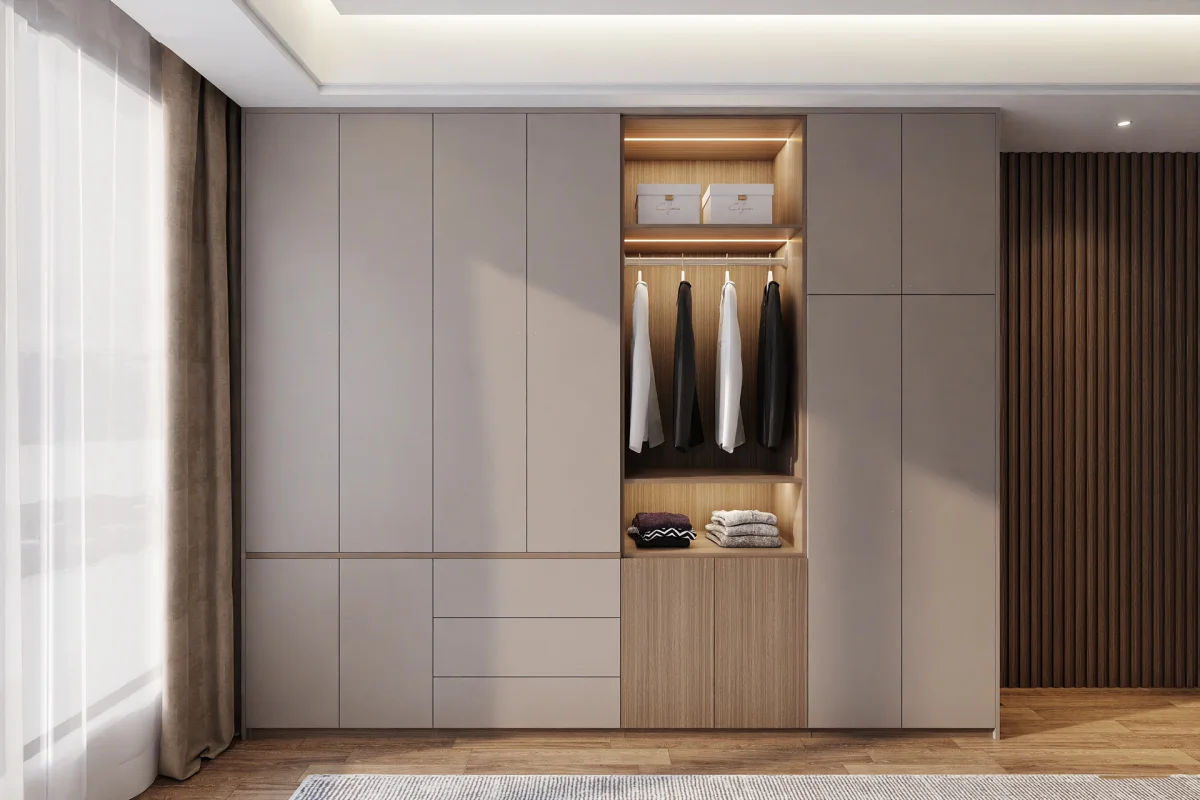
Cabinet material determines how long custom furniture lasts, how it handles moisture and how environmentally sound it is. This guide covers seven cabinet materials — particleboard, plywood, eco-board, OSB, MDF, solid wood and melamine-faced solid wood — by production process, pros and cons, suitable applications and available environmental grades.
Cabinet material determines how long custom furniture lasts, how well it handles moisture and how environmentally sound it is. The materials our factory in China commonly uses for cabinet bodies are particleboard, plywood, eco-board, OSB, MDF, solid wood and melamine-faced solid wood. Their production, strengths and weaknesses, and suitable applications are not the same, so "which board is better" cannot be answered in one word.
Production: wood chips bonded with adhesive and pressed under high temperature. Flat, stable and cost-effective; suitable for wardrobes, bookcases, shoe cabinets and other dry areas. Weakness: limited moisture resistance — it swells when exposed to water. Available environmental grades: HENF, ENF, E0, E1.
Production: thin wood veneers stacked crosswise. Better moisture resistance and load-bearing capacity than particleboard; suitable for kitchen base cabinets, balcony cabinets, laundry cabinets and basement cabinets — damp locations. Weakness: large door panels may warp slightly, so door height should stay under 2.2 m (or be split into upper and lower doors), with door width within 600 mm. Available environmental grades: ENF, E0, E1.
3. OSB (oriented strand board).
Production: large wood strands laid in oriented layers. Strong resistance to deformation; stable for 2.4 m high door panels. MDI adhesive is commonly used. Available environmental grades: ENF, E0, E1.
4. MDF (medium-density fibreboard).
Production: wood fibres pressed into a dense, fine-surfaced board. Suitable as the substrate for shaped door panels, including vacuum-formed (membrane-pressed) doors. Weakness: poor moisture resistance — it swells when wet, so it is not recommended for cabinet bodies. Strength: it can be shaped into Chinese, new-Chinese, European and American style door panels, with high decorative value. Available environmental grades: ENF, E0, E1.
Production: a core of wood strips with veneer on both faces and a melamine (no-paint) surface — long used by on-site carpenters. Weakness: relatively soft, not suitable for door panels because it deforms easily; suitable for cabinet bodies. Cost is on the higher side. Available environmental grades: ENF, E0, E1.
6. Solid wood (finger-jointed or whole-board).
Production: solid timber joined or used as a single board, with little adhesive. Weakness: higher price and prone to expansion, contraction and cracking. Mainly used for high-end door panels; rarely for a complete cabinet body.
7. Melamine-faced solid wood.
Production: rubberwood or pine core of wood strips with a melamine (no-paint) surface. Mostly used for cabinet bodies; stability is acceptable, with many colour options and a stronger look. Weakness: relatively soft, not suitable for door panels because it deforms easily; suitable for cabinet bodies. Cost is on the higher side. Available environmental grades: ENF, E0, E1.
When choosing, decide by location: particleboard is a reasonable first choice for cabinet bodies in dry areas; plywood is recommended for damp locations such as kitchens, balconies, laundry rooms and basements; OSB can be used where 2.4 m high door panels must resist deformation; MDF is the substrate for shaped door panels; eco-board or melamine-faced solid wood can be considered when budget and colour variety matter; solid wood suits high-end door panels. The environmental grade and test report of the chosen material should always be confirmed.
Our factory cabinet materials cover the HENF, ENF, E0, FAS and F4-star environmental standards. The final choice depends on the application, budget and project requirements.
Beijing Jiangli Furniture Co., Ltd. operates its factory in Gaobeidian, Hebei Province. We provide OEM/ODM and processing of customer-supplied materials — customers may purchase raw materials and have them processed at our factory — and we work with decoration companies, interior designers, design studios, custom-furniture dealers and engineering projects.
北京将历家具有限公司工厂常用柜体材料有 7 种:颗粒板(木碎料高温压合,平整不易变形、性价比高,适合衣柜、书柜、鞋柜等干燥区域,防潮弱)、多层板(薄木片纵横叠压,防潮承重好,适合厨房地柜、阳台柜、洗衣柜、地下室等潮湿位置,大门板易轻微翘曲,建议门板高 2.2 米以下或分上下两段、宽 600mm 以内)、OSB 欧松板(大片木片定向铺装,抗变形强,2.4 米高门板稳定性强,多用 MDI 胶)、MDF 中纤板(木粉压制、表面细腻,适合造型门板与吸塑模压门基材,防潮差、不建议做柜体)、生态板(木条板芯+两面单板+三聚氰胺免漆,适合柜体、不适合柜门,偏软易变形、成本偏高)、实木板(原木拼接或整板,用胶少、价格贵、易热胀冷缩开裂,多用于高端柜门)、实木免漆板(橡胶木/松木木条板芯+三聚氰胺免漆,适合柜体、花色多、偏软不适合柜门)。可选环保等级包括 HENF、ENF、E0、FAS、F4星。
定制家具的加工周期通常在 15~45 天区间(受板材、工艺与排产影响);具体工期以正式确认的结果为准。
常见可选颗粒板、多层板、生态板、OSB 欧松板、中纤板与实木(含实木免漆)。柜体多用颗粒板或多层板,主要看握钉力、防潮性与预算;柜门按风格选 PET、吸塑、双饰面或烤漆。具体以现场尺寸与确认方案为准。
可以。服务北京、天津、廊坊、保定、雄安新区及周边,上门测量通常在 1–7 天内安排,测量当天现场复尺一次。
按投影面积或延米计价,受板材、门板工艺、五金与是否需要异形影响;给到空间长宽高和柜型可先给参考区间,最终以现场尺寸和确认方案为准。
NEXT STEP
Send us your space dimensions and we will give an indicative range based on projected area and linear meters
No deposit and no need to visit first. Tell us the space and its width and height, and we will calculate it by our Beijing-Tianjin-Hebei on-site measurement standard.
WeChat jianglijiaju (please mention "custom furniture")
These pages cover the details this article leaves out
Our own furniture production site in Gaobeidian, Hebei.
Cabinets planned around your actual space and usage.
Equipped for cutting, edge banding, side drilling and more.
Delivery and installation for custom furniture.
Tell us what you need and we will get back to you shortly.